
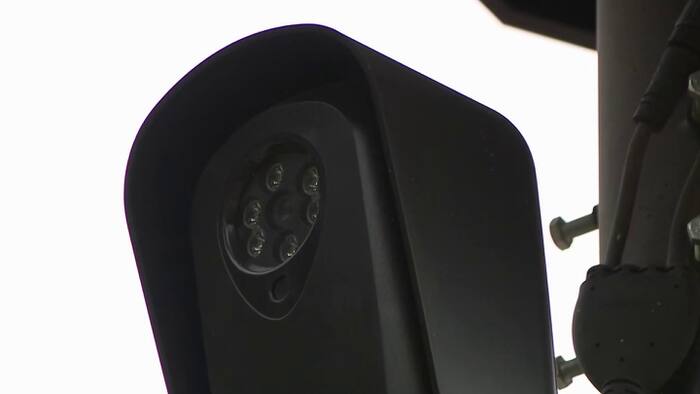
The Harris County Sheriff’s Office has updated its policy governing automated license plate reader cameras — known as Flock cameras — after three deputies had their access suspended over allegations of misuse.
The new rules put restrictions in writing for the first time, spelling out exactly who can search vehicle location data, what justification is required, and who is responsible for checking the work.
Under the updated policy, only authorized detectives and deputies at the rank of sergeant or above may access Flock camera data. Every search must be tied to an active case or investigation, and employees are required to document their reasonable suspicion that a crime has been committed before running a search.
The department will also require weekly audits to flag unusual activity. Those audits will be reviewed by an ALPR commander — a lieutenant or above — and any suspected misuse will be forwarded to the Internal Affairs Division for investigation.
Hotlists — the lists of license plates flagged for real-time alerts — are limited to 100 plates, expire within 30 days, and can only be created by detectives or deputies at the rank of sergeant or above.
The policy also states that ALPR hits alone cannot be treated as reasonable suspicion to detain someone or probable cause to make an arrest. Deputies must confirm a hit visually and consider all surrounding circumstances before taking action.
All ALPR data stored on a system maintained by HCSO is permanently destroyed 30 days after it is collected, unless it is connected to an active criminal investigation.
Residents interviewed near the cameras had mixed — but cautious — reactions to the technology.
“I believe they’re good if you use them for the right purposes,” said Jerry Gray.
Lisa Worcester expressed skepticism. “I think I see more for race of people, you know, not security,” she said.
Gary Love pointed directly to the suspension of three deputies as the reason trust has eroded.
“We hold them to a higher standard. And they should hold themselves to an even higher standard than we do,” Love said. He called the new policy “a good start,” adding: “As long as they work out the kinks and the busts I’ve been hearing about — about misuse and abuse.”
Gray echoed that conditional support. “It’s a good change if they follow the procedure and protocol to do it right,” he said.
Worcester struck a wait-and-see tone. “We have to see if they really do what they say they’re going to do,” she said.
The policy changes are not the final word. An oversight group is currently reviewing how Flock data is collected across Harris County, with recommendations due to Commissioners Court in February.
The sheriff’s office policy also requires at least an annual external audit, coordinated with the Harris County Auditor’s Office, to review HCSO’s auditing practices for the camera system.


