
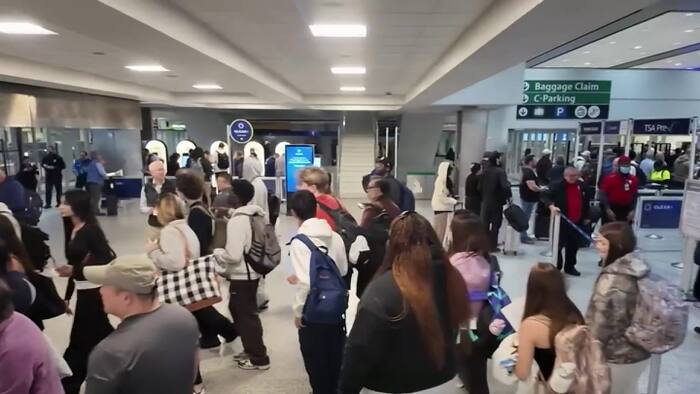
Tom, a traveler from Montana, was at the airport when the screens told the story.
“The signs started saying canceled, canceled, canceled — what’s going on here?” he said.
The ground stop derailed his and his wife’s planned trip to the Galápagos Islands and quickly turned their vacation into a fight to get their money back. When asked if he received a refund, Tom said simply: “No, not yet.”
On top of that, he was hit with an unexpected hotel bill — in an area where options near the airport were scarce.
“There was nothing near the airport,” Tom said. “There was no effort, and I don’t blame them — the airlines.”
Under current rules, passengers affected by a cancellation are entitled to one of two things: a full refund if they choose not to travel, or a rebooking on a new flight — not both. Hotels, meals and ground transportation are a different matter, particularly when the disruption stems from something outside an airline’s control.
Katy Nastro, aviation and travel correspondent at Flighty, said the gap in consumer protections becomes especially clear in a situation like Friday’s FAA system failure.
“We don’t have regulations that cover travelers when something happens outside of the airline’s control with extra benefits,” Nastro said.
“We unfortunately don’t have compensation on top of all of that,” she added.
Nastro said some travelers affected by the ground stop were unable to rebook for 72 hours or more, leaving many still making their way home days later. While a handful of airlines have offered hotel and meal vouchers, that assistance is not guaranteed.
“It will say that we have heard that airlines are providing hotel vouchers and meal vouchers on a case-by-case basis for those impacted overnight,” Nastro said.
For travelers who want to know what they are entitled to when a disruption is within an airline’s control, Nastro pointed to a federal resource: flightrights.gov, the Air Traveler Consumer Rights Dashboard.
Starting in February, the U.S. Department of Transportation will require airlines to report delays and cancellations under a new, separate category established by the 2024 FAA Reauthorization Act. The rule carves out 10 specific events that will no longer count against airlines in the existing Air Carrier reporting category — meaning airlines face no additional compensation requirements when those events cause disruptions.
The 10 events include a government system shutdown or failure that directly and unexpectedly affects an airline’s ability to operate safely — the type of disruption that grounded flights Friday — as well as aircraft damage caused by extreme weather, foreign object debris or sabotage; cybersecurity attacks; unscheduled maintenance that cannot be deferred before flight; and an airport closure due to volcanic ash, wind or wind shear, among others.
Nastro said one change stands out as especially significant for everyday travelers: the reclassification of unscheduled maintenance events.
“Coming in February, a few different categories are now taken from within the airline’s control and put into that other bucket outside of the airline’s control, meaning they’re not at fault,” Nastro said. “One occasion in particular is really noteworthy for travelers — when there’s an unscheduled maintenance event, meaning that you show up for your flight and unfortunately something happened to the plane, and they’re not able to rectify that maintenance issue within the time that it takes to get your flight out and back on track.”
Under that scenario, passengers who hit the three-hour mark for a domestic delay would still only be entitled to a refund or a rebooking — nothing more.
“So it really takes the little rights that you have away,” Nastro said.
The rule change could also make it harder for travelers to comparison-shop airlines based on on-time performance. Because certain disruptions will now be reported in a separate category, they may no longer weigh against an airline’s published on-time arrival rate — potentially making some carriers appear more reliable than they are.
Nastro urged travelers not to put too much stock in those numbers.
“I would take on-time arrival rates with a grain of salt and just understand that there are certain times of the year that are really more traveled than others,” she said. “You have a higher likelihood of encountering some sort of disruption.”
She noted that December, January and February, along with July and August, are historically the worst months for travel disruptions — driven largely by severe weather.
Tom said he’s largely come to terms with the situation.
“If it’s not specific to an airline, it’s not their problem,” he said.
As of Monday, he was still waiting to head home — and staying optimistic.
“Hopefully gonna get through today,” he said.
As passengers continue returning to George Bush Intercontinental Airport, a separate issue has emerged: baggage claim remains chaotic, with numerous reports of missing bags. Travelers say they wish they had used luggage trackers — or skipped checked bags altogether and flown with carry-ons only.
For travelers looking to protect themselves before their next trip, Nastro recommends reviewing flightrights.gov to understand what airlines are obligated to provide — and to consider travel insurance, particularly for international itineraries where the stakes are higher.


