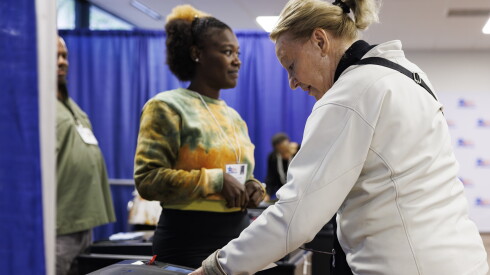
As soon as Justin Labonte was old enough to vote, he made it a point to cast a ballot. He hasn’t missed an election since.
Labonte, 30, was among the earliest to arrive Thursday morning at the Chicago Voting Supersite, 137 S. State St. in the Loop, on the first day of early voting for the 2026 general election.
“I've never missed an election since I turned 18, and I certainly don't want this to be my first,” said Labonte of the West Elsdon neighborhood on the Southwest Side.
Early voting also began Thursday at the nearby supersite located at the Chicago Board of Elections office at 69 W. Washington St., 6th floor. Vote by mail has also begun.
For the first time, voters will elect the entire Chicago School Board, including its president.
The ballot will also feature races for U.S. Senate, Congress, Illinois governor, attorney general, comptroller, treasurer and secretary of state, as well as seats in the Illinois General Assembly. Cook County voters will decide races for county board president and commissioners, while voters in the collar counties will see a range of additional local contests.
“I hope that voters realize the issues before them, whether they're for the issues or against the issues,” said Marisel Hernandez, chair of the Chicago Board of Elections, said at a morning news conference at the supersite. “I'm hoping that voters will come out and express their views through the ballot.”
Growing up in a predominantly immigrant community on Chicago’s Southwest Side, Labonte said he recognized from a young age the importance of exercising his right to vote on behalf of those who can’t.
“From such a young age I knew how important this was and how other people do rely on you, whether it's non-citizens or children. They need us,” he said.
For Alex Birchmeier, this year’s general election was “super important,” and he wanted to make sure to get his vote in as early as possible.
“We’ve got to make sure that our voices are heard and we're not letting the powers that be just keep on with the power grab,” said Birchmeier, 40, of Old Town.
Birchmeier, who has lived in Chicago for more than 15 years, said he believes the city is “on the up and up” and hopes to see that progress continue. He said voting in the general election is a way to ensure Illinois’ elected officials continue protecting residents while keeping “federal powers in check.”
Lincoln Park's Patricia Tennison was another early bird casting a ballot. “If you do it early, then small things won't get in your way,” she said.
Tennison, 80, said she hoped voters would elect people who would hold the Trump administration accountable.
“Everybody's got to get out and put their vote in,” Tennsion said. “It may seem small, but it does really count. The numbers count.”
Voter turnout for the midterm election in Chicago is usually between 48% to 52%, said Hernandez, except in 2018, when there was a 60% turnout.
Hernandez acknowledged fears in the community that federal immigration officers could be present at polling places. She said the Board of Elections is working with local, state and federal law enforcement agencies to ensure voters can vote without threats or intimidation.
“We are also very prepared to go to court if necessary to enforce federal and state laws,” said Hernandez. “We have laws that protect voters from intimidation, threats and coercion.”
For those reasons, Labonte said voting early is especially important for anyone who fears threats or intimidation could prevent them from casting a ballot on Nov. 3.
“Vote early, vote in person and do research on what's going to be on the ballot,” said Labonte.