
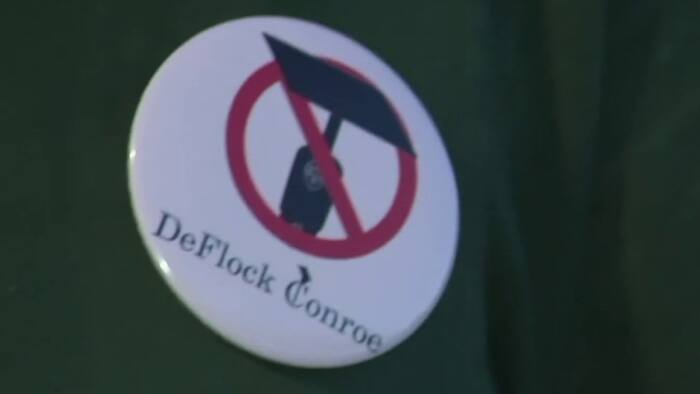
A group of Conroe residents is one step closer to potentially putting a sweeping ban on Flock cameras and other mass surveillance technology before voters.
On Wednesday, Nov. 18, Conroe resident James Fletes submitted a petition containing approximately 2,205 signatures, more than double the number they believe is required to trigger the city’s citizen initiative process.
Fletes organized an effort called DeFlock Conroe.
The proposed ordinance would prohibit the city from operating or routinely accessing automated license plate reader systems and other technology used to systematically track members of the public who are not under investigation.
“I just don’t feel comfortable with the company and I don’t feel comfortable that they’ve set up so quickly such a massive surveillance network across not just Houston, but the entire country,” Fletes previously told KPRC 2.
The petition comes after Conroe City Council declined in August to place a binding referendum concerning the city’s surveillance cameras before voters.
Fletes said organizers spent weeks collecting signatures, including during early voting, when volunteers spoke with thousands of Conroe residents about the proposed ban.
“The goal was a little over, a little under a thousand signatures, and then we’ll be turning in about 2,205 today,” Fletes said.
According to the citizen-drafted ordinance, Conroe’s Home Rule Charter requires signatures from qualified voters equal to 20% of the votes cast in the last regular municipal election.
The document estimates that approximately 963 valid signatures would be needed based on the May 2, 2026, municipal election. However, the final required number must be confirmed by the city.
Fletes said the conversations organizers had with residents revealed a range of opinions about the technology.
“The majority supported what we were doing, knew about it, were engaged, had been following since social media,” Fletes said. “So it’s just really good to finally see the community to actually get a say in this matter here in Conroe.”
He said even some residents who support Flock cameras signed the petition because they believed voters should have the opportunity to decide whether the city continues using them.
“We had people that support Flock cameras, but they didn’t like the fact that we didn’t get to vote on it,” Fletes said. “So they were there just to support getting a vote in the matter, knowing that they’re probably gonna vote to support them.”
Fletes said the goal is to restore public participation in the decision.
“That’s all we wanted to do is bring back that voting process to Conroe,” he said.
Two Conroe residents who signed the petition say their concerns go beyond the cameras themselves.
Jessica Fuentes, who also helped collect signatures, said she initially knew little about the technology until she began attending City Council meetings earlier this year.
“I’m also not comfortable cameras following my movements during the day,” Fuentes said. “And I have several Flock cameras that basically, no matter what way I take to work, they’re everywhere.”
Fuentes said she understands the technology can help law enforcement investigate crimes but worries about privacy and the potential for misuse.
“I feel for me, the importance is just raising awareness,” she said.
Another Conroe resident, Robert Brown, said the cameras have raised serious concerns about constitutional rights and the possibility of innocent drivers being mistakenly identified.
“They’re a Fourth Amendment violation of our rights, straight up,” Brown said.
Brown said he has even considered moving out of Conroe if voters ultimately decide to keep the cameras.
“There’s other cities around that have voted or decided to do away with them all together,” Brown said. “Could be a possibility to move to one of those places. I mean that’s on the table.”
The proposed ordinance, titled “An Ordinance Limiting City Mass Surveillance and Systematic Tracking,” goes beyond Flock Safety cameras.
If adopted, it would prohibit Conroe from purchasing, operating, funding, subscribing to or obtaining routine access to systems that systematically collect searchable information about people who are not subjects of a specific lawful investigation.
That includes:
The ordinance is written to prevent the city from simply replacing Flock cameras with similar technology from another company.
It would also prohibit Conroe from circumventing the ban through routine data-sharing agreements or standing arrangements with other law enforcement agencies or private surveillance networks.
The ordinance would not prohibit all police cameras or investigative technology.
Conroe police could continue using body-worn cameras, dashboard cameras and conventional security cameras.
The proposal would also preserve targeted drone operations for specific investigations, search-and-rescue missions, emergencies and other lawful public safety purposes.
Traffic monitoring systems that measure congestion or roadway conditions without creating searchable histories of individual vehicles would also remain permissible.
However, the ordinance draws a distinction between investigating a specific crime and collecting information about the general public for possible use in future investigations.
Under the proposal, even a warrant or court order would not automatically authorize Conroe to maintain routine access to a mass surveillance database built by systematically collecting information about people who were not investigative targets.
The ordinance would not prevent police from complying with binding court orders or obtaining evidence through otherwise lawful investigative methods.
Fletes acknowledged that not everyone he spoke with supported eliminating the technology.
He said organizers encountered residents who believe automated license plate readers help police solve crimes, including a law enforcement officer involved in recovering children.
“He said that he enjoys the technology and that it does help him with his job, but also that he believes that there should be strict limitations on it, that it should be having a warranted process,” Fletes said.
Others expressed stronger opposition to the cameras.
“And then we spoke to people who just outright hate them,” Fletes said. “And whether they know why they hate them or not, they don’t like being spied on.”
The debate reflects competing concerns over public safety and privacy as communities consider how much surveillance technology police should be allowed to use.
Supporters of automated license plate readers argue the technology can help investigators identify suspect vehicles, locate stolen cars and solve serious crimes.
Opponents question whether collecting and storing information about drivers who are not suspected of wrongdoing creates unnecessary risks to privacy.
The proposed ordinance would require Conroe to stop operating prohibited surveillance systems as soon as legally permissible.
The city would also be prohibited from renewing, extending or replacing contracts for substantially similar surveillance capabilities.
However, the ordinance would not require the city to violate an enforceable contract or incur an early termination penalty that City Council has not approved.
That means existing agreements could affect how quickly the city would be required to shut down its cameras.
The proposal would also require Conroe to delete city-controlled surveillance data when legally permissible, while preserving records required for investigations, court proceedings or other legal obligations.
Additionally, the city would be required to publish quarterly reports identifying prohibited surveillance systems still in operation, their vendors, annual costs and available information about access by outside agencies.
The petition must first go through the city’s verification process.
Fletes said the city secretary has five days to count the signatures. The proposed ordinance separately cites a charter process under which City Council would have 10 days to adopt the measure or call an election. The city’s official timeline and signature requirements have not yet been independently confirmed.
If the petition qualifies, the ordinance could be adopted by City Council or potentially submitted to voters in May.
Fletes said he hopes Conroe follows the example of League City, where voters recently rejected the continued use of Flock cameras.
If the ordinance ultimately goes before Conroe voters and is approved, it would take effect once the election results are canvassed and certified, or earlier if required by applicable law.


